Sharifa has done an amazing job of researching lobate. Below is a summary of her work with a few choice words pulled in from the research links to highlight points of interest to the UNAVERZ Crew as we turn her into a Comb Jelly!
—
Sharifa writes:
Here is a summary of my research on comb jellies. I pulled data from 7 primary sources.
There are 3 groupings of Comb Jellies. We are building a lobate.
Main Thing:
A bird has 2 wings, not 3. A comb jelly has 8 combs.
Image Links:
lobed comb jelly
comb jellies
comb jelly
Tree Of Life Web Project
Encyclopedia of Life
Great 2 Minute Video:
Iridescent Ctenophores from Parafilms on Vimeo.
Writings:
Wikipedia – Ctenophora
Monterey Bay Aquarium – Comb jelly
Monterey Bay Aquarium – Bloodybelly comb jelly
Smithsonian – Jellyfish and Comb Jellies
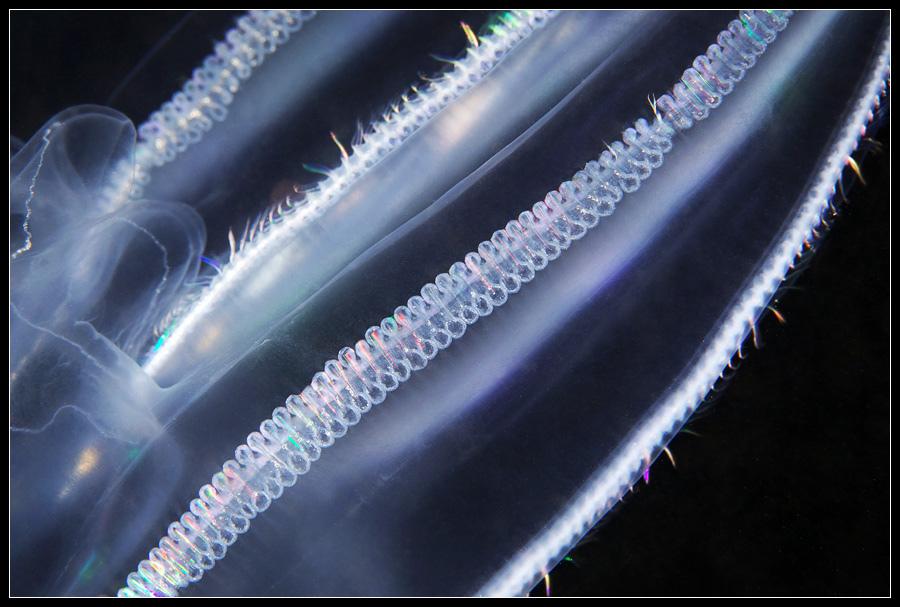
Comb jellies are named for their unique feature: plates of giant fused cilia, known as combs, which run in eight rows up and down their bodies. The combs act like tiny oars, propelling the comb jelly through the water. Many microscopic organisms, such as bacteria, also use cilia to swim—but comb jellies are the largest known animals to do so. The comb-rows often produce a rainbow effect. This is not bioluminescence, but occurs when light is scattered in different directions by the moving cilia.
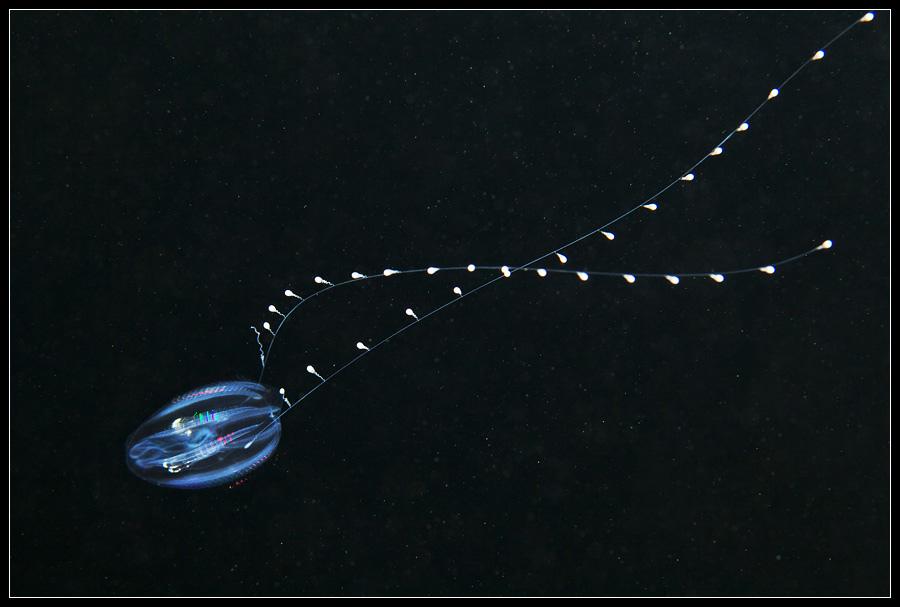
LOBATES are defined by two flattened lobes that extend from the typical rounded ctenophore body down below their mouths. They also have short tentacles and tend to grow larger than cydippids.
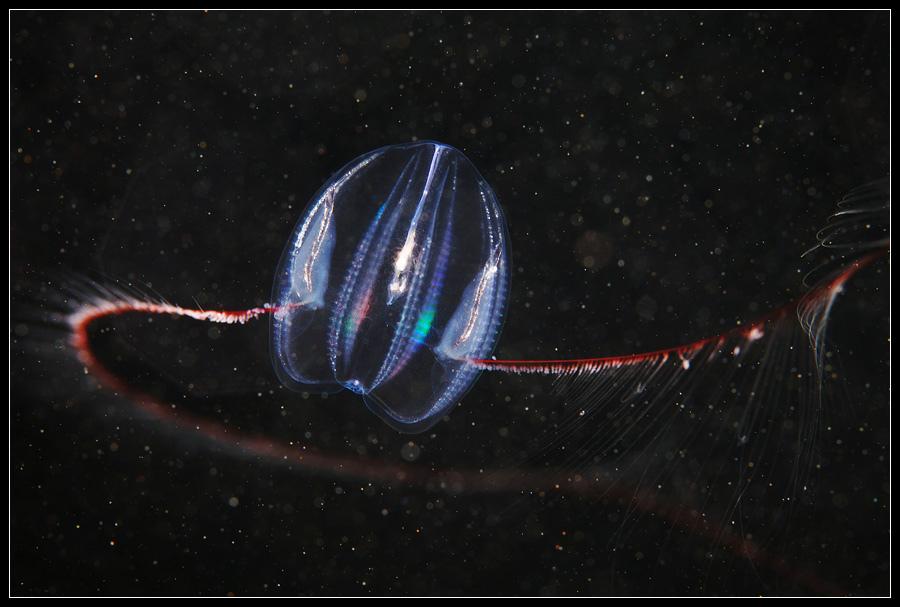
Jellies have also adapted their body color to camouflage in the darkness. Most are nearly colorless and transparent, so they can be difficult for predators to see. However, some deep sea jellyfish and comb jellies are a bright red or orange color. Why would they be red instead of black to blend in with the dark water? Red cannot be seen in dark water (deeper than 200 meters), so there’s no greater protection from black than red. But red is preferred to black because pigment is easier for animals to produce. Some deep sea jellies just have dark red guts, possibly serving to mask luminescent prey from other larger predators with eyes.
UC Museum of Paleontology – Ctenophora
Claudia E. Mills – Ctenophores
Ctenophores, or comb jellies, are the common names for animals in the Phylum Ctenophora. In American English, the name is pronounced with a silent “c”, as “teen-o-four” or “ten-o-four”. The preliminary “c” is pronounced in most European languages (as a syllable “ka”). Ctenophores are characterized by eight rows of cilia, which are used for locomotion. The cilia in each row are arranged to form a stack of combs, also called comb plates, or ctenes; thus the name ctenophore comes from the Greek, meaning “comb bearer”.
Common coastal representatives of the order Lobata include members of the genera Bolinopsis and Mnemiopsis. These “lobate” ctenophores are usually larger than coastal cydippids, and have a pair of highly expandable lobes that are used as sticky prey capture surfaces, accompanied by short tentacles that remain inside the lobes. Like cydippids, lobate ctenophores also feed primarily on small planktonic prey.
One of the most delightful characteristics of ctenophores is the light-scattering produced by beating of the eight rows of locomotory cilia, which appears as a changing rainbow of colors running down the comb rows. Many people assume that they are seeing bioluminescence when they see this rainbow-effect, but really this is simple light diffraction or scattering of light by the moving cilia. Most (but not all) ctenophores are also bioluminescent, but that light (usually blue or green) can only be seen in darkness.
Nearly all comb-jellies (Phylum Ctenophora) can make light, but the best-known species Pleurobrachia has not been found to luminesce. Because ctenophores can produce brilliant colors from diffraction through their comb plates, people get the impression that they are seeing bioluminescence. Even marine biology books sometimes mention the red luminescence.